Every rental business has the same problem: some customers simply disappear. They’ve rented from you before, they know your service, they’re generally happy — but they don’t come back. Not because you did anything wrong. Maybe it’s the season, a vacation, or they just never had a reason to stop by again.
The good news: these customers can be brought back. And more often than not, all it takes is a simple, well-timed message. If you have order history, SMS integration, and flexible triggers, winning customers back can work almost like its own workflow — no manual routine, no spreadsheets, no “guessing by eye” reminders.
Why customers go quiet
There’s usually more than one reason. The most common ones:
- they stopped renting after the season ended;
- they simply didn’t need equipment this month;
- they forgot about you;
- they found you by chance, not because they were looking for your service;
- nothing gave them a reason to come back.
That’s why win-back works best not with a generic “come again” but with a clear scenario:
- no rental for 30 days;
- no rental for 45 days;
- a customer who used to rent often, then went silent;
- a customer who hasn’t visited a specific location in a long time.
This is no longer mass mailing — it’s working with specific behavior.
What you can do in Turborent
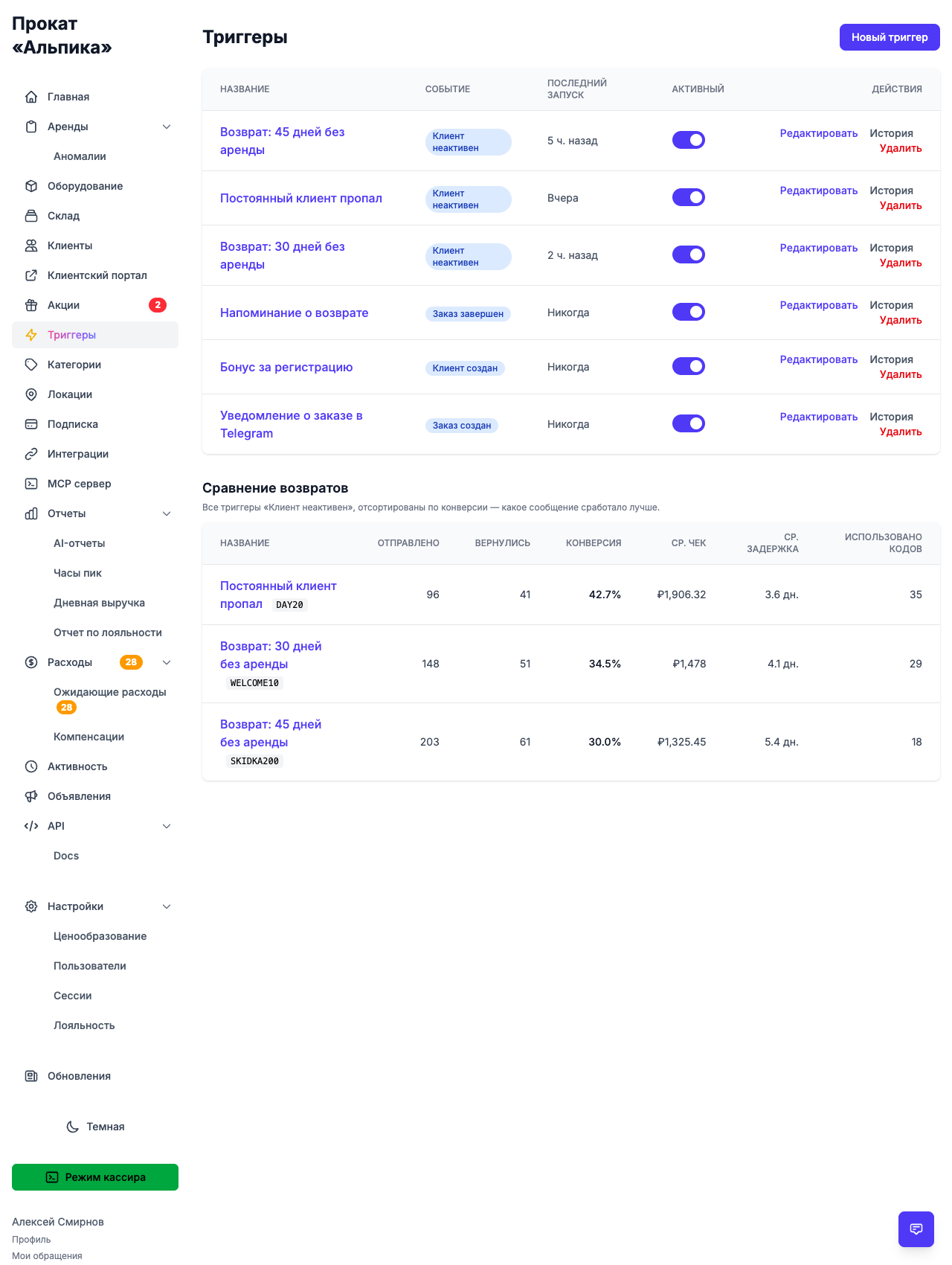
In Turborent you pick a condition, and the system tracks the right moment and sends the message:
- if a customer hasn’t rented for 30 days — send an SMS;
- if a customer didn’t come back after the first reminder — send a second message 7 days later;
- if a customer used to rent often but went quiet — move them to a separate segment;
- if a customer hasn’t visited a specific location in a long time — remind them about that location, with its name inserted into the message automatically.
You build scenarios around your business, not around a template.
Which triggers work best
You don’t have to build a complex chain right away. Start with simple triggers.
No rental for 30 days
The most universal scenario. If a customer hasn’t rented for a month, it’s time for a gentle reminder:
Hi! We haven’t seen you at our rental for a while. If you need skis or other sports gear again, we’d be happy to help. Drop by whenever it suits you.
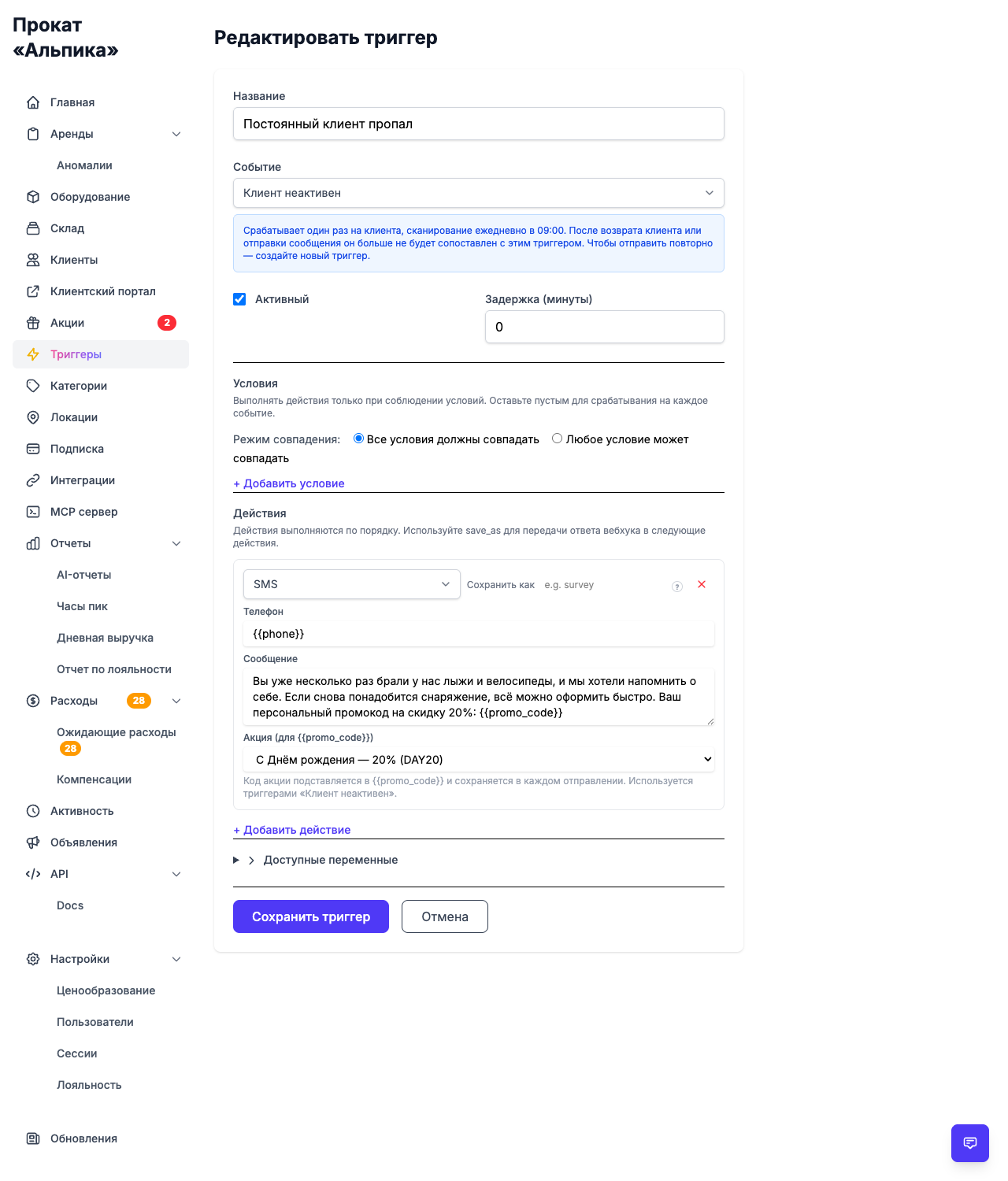
If you want to add an incentive, include a small bonus — the promo code is inserted into the message automatically:
Come back within a week and get 10% off your next rental. Your code: {{promo_code}}
No rental for 45–60 days
This is a colder segment. Better not to push — just remind them that you’re still around:
Just a reminder that you can still arrange a rental quickly at our place, without extra hassle. If you need gear, we’re here.
A regular customer who disappeared
If someone used to rent regularly and then stopped, they’re an especially valuable segment — easier to win back than a brand-new customer. This scenario is built on the “order count greater than N” condition:
You’ve rented our bikes several times, and we wanted to say hi. If you need gear again, everything can be arranged quickly.
Seasonal win-back
For many rental businesses, customers don’t “leave” — the season just ends. Plan the chain ahead of time: at the end of the season, before the new one starts, and during the first weeks of active demand. That way you reach people exactly when demand is already rising naturally.
Why SMS often works better than email
Email is fine, but SMS is read faster — and for win-back, response speed matters. SMS is especially useful when a customer hasn’t visited in a long time, the message needs to be short, and decisions in your niche are made throughout the day.
A good SMS usually contains: who’s writing, why, what to do next, and — if needed — a short incentive:
Our rental: haven’t rented gear from us in a while. Reach out and get 10% off your next rental.
How to keep your messages from being annoying
Win-back messages should help, not get in the way:
- don’t send too often;
- don’t repeat the same message;
- don’t push discounts every week;
- segment customers by behavior;
- keep it short and to the point.
One good message after 30 days of silence beats three identical reminders in a week.
Using triggers flexibly
The real value isn’t the SMS itself — it’s that triggers can be configured around your scenario. For example, you can build this chain:
- no rental for 30 days — first SMS;
- no return within 7 days — second SMS with new copy and a promo code;
- a customer with a high loyalty balance — a separate message with a better offer;
- a customer who hasn’t visited a specific location in a long time — a reminder about that location;
- a customer who returned after a campaign — automatically excluded from the next cycle.
You’re not just “running a mailing” — you’re building a living win-back system.
What to write in the message
Simple options work best: a pressure-free reminder, a short bonus, a specific reason, a seasonal offer, a return to a familiar service. Here are a few examples:
We haven’t seen you in a while. If you need gear again, we’re right here.
Just a reminder: you can arrange a rental quickly, without long calls or waiting.
Come back in the next few days and get a discount on your next rental.
The season is starting, and the skis are ready for pickup!
What really matters to measure
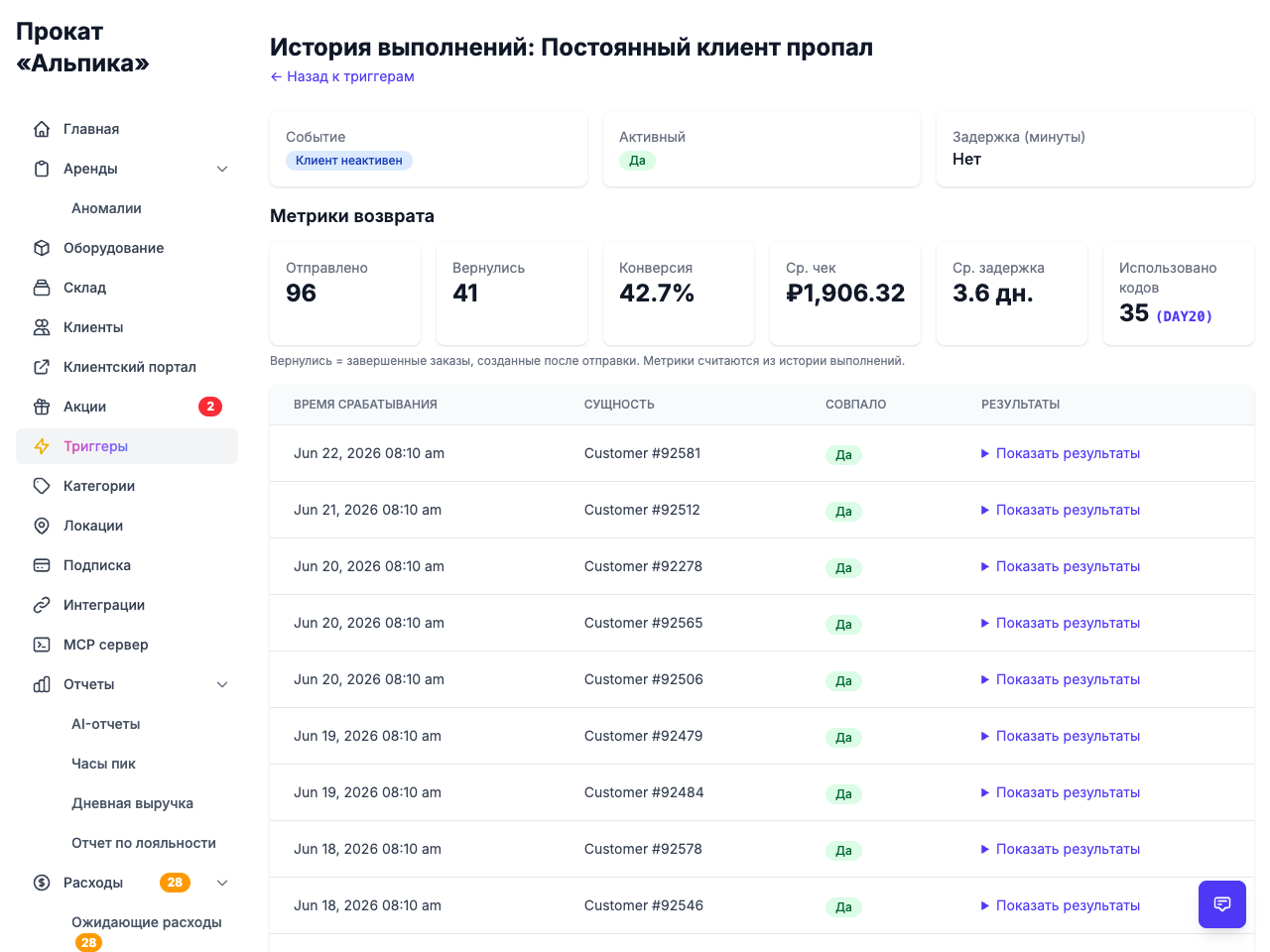
To see whether a scenario works, look beyond message deliveries. What matters more:
- how many customers came back;
- what share of them rented again;
- the average receipt of returning customers;
- which messages performed best — Turborent compares your campaigns side by side;
- how long it took between the reminder and the next rental.
Sometimes a simple message without a discount outperforms a promotion.
The bottom line
Customers rarely get “lost” forever — more often they just fall out of their usual rhythm. And if you remind them at the right time, many of them come back.
SMS integration and triggers give you a convenient tool for this: pick the right segment, set the exact moment of delivery, build your own win-back scenario, and keep testing and improving your messages.
The best part is that the system works not by a template but by your rules. Which means you win customers back in the way that fits your business.